Custom earplugs for professionals, by sector
A building site asks something different of hearing protection than a food production hall, a distribution centre or a nursery. On this page you find a guide for each sector on what noise is involved, what employees need to keep hearing and which filter suits it.





What matters in each sector?
The same health and safety rules, but a very different noise. A short outline per sector.
Construction and industry
Volandis gives 90 dB(A) as the average on a building site. Tools such as a circular saw or angle grinder go well above that. The standard is a DI filter with 26 dB SNR.
Food and pharma
Cutters, packaging lines and cooling systems. In the meat sector, hearing protection must be detectable and attached to a cord. We supply a DI filter in a metal detectable and X-ray visible version.
Transport and logistics
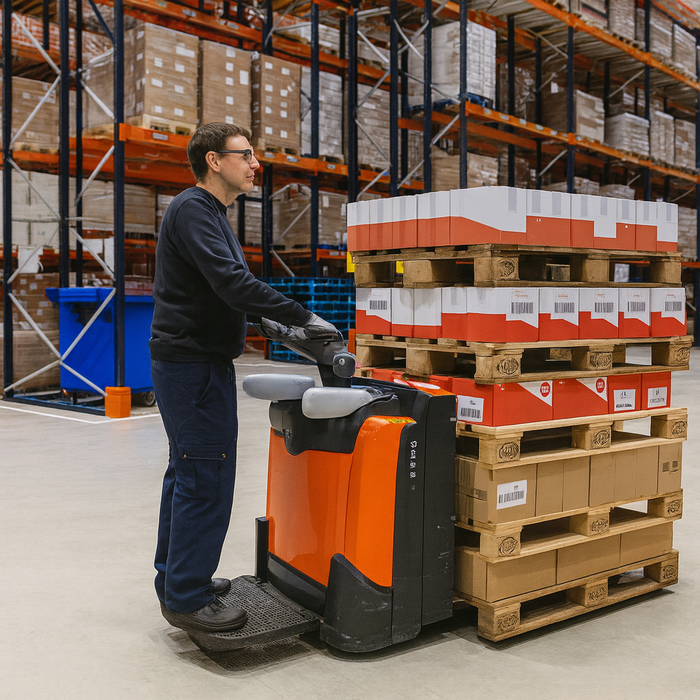
The cab is usually quiet, the noise is in loading and unloading and in the warehouse. Forklifts and reversing alarms must stay audible.
Hospitality and events
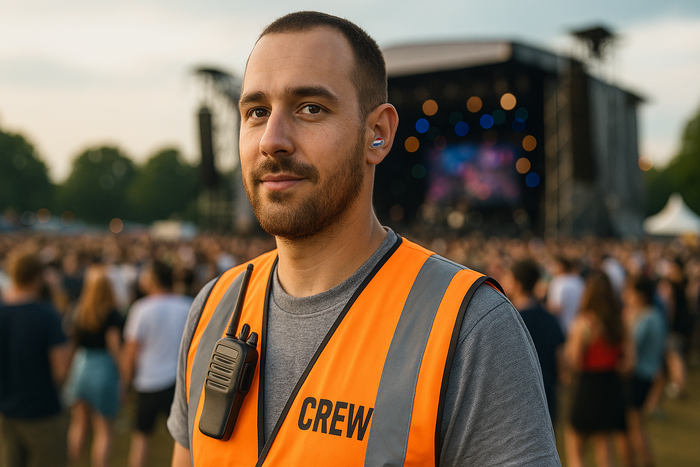
Amplified music, for a whole shift. A DM filter reduces the volume without making the music dull, so orders stay intelligible.
Healthcare and education
In measurements, most PE teachers were above 80 dB(A). In childcare and healthcare it is more about nuisance, see also hearing protection in childcare and in the dental practice. A DM or light DR filter, depending on the place.
Office
No harmful noise, but a nuisance in the open-plan office. A light DR filter for focus, while colleagues can still talk to you.
Which hearing protection suits your work?
Three questions decide the choice. How loud is it and what kind of noise is it? What needs to stay audible? And what are the requirements of the workplace itself?
Start with the noise, not with the product
You choose hearing protection based on the risk inventory and evaluation (RI&E). It shows how loud the noise is in which place and how long employees are exposed to it. Continuous noise from a machine calls for something different than short, loud bangs from a hammer or press, and amplified music for something different again. If you do not measure, you do not know how much attenuation is needed.
Too much attenuation is just as much a problem as too little. Anyone who can no longer hear colleagues, signals or the radio takes the earplugs out. Then the protection is zero.
The filter makes the difference
Audibling custom earplugs have an interchangeable membrane filter from Dynamic Ear Company. That way you choose per type of work.
- DI is for industry, construction, production and logistics. Flat attenuation in the low frequencies, so speech stays intelligible, and extra attenuation from about 4 kHz. Also available in a metal detectable and X-ray visible version.
- DIM is a level-dependent filter for impulse noise, such as hammer blows, presses and shots.
- DM gives flat attenuation with natural sound, for music, the stage and hospitality.
- DR is a compact filter for general use, such as focused work and lighter noise exposure. It suits, for example, hearing protection in childcare, where you want to keep understanding the children well.
Because the filter is interchangeable, an employee who changes jobs can keep the same custom earplugs.
What the Working Conditions Act requires of the employer
The Dutch Working Conditions Decree (Arbobesluit) works with three thresholds for daily exposure over 8 hours.
- Above 80 dB(A) the employer provides suitable, individual hearing protection and gives information.
- From 85 dB(A) wearing it is mandatory. The employer marks the noisy areas, carries out a plan with technical and organisational measures and offers regular hearing tests.
- 87 dB(A) is the limit value in the ear, so with the attenuation of the hearing protection taken into account.
Hearing protection only comes after measures at the source, such as quieter machines or shielding. The sector guides show how this works out in your sector.
Why custom-made protection gets worn more
Custom earplugs are made from an impression of the ear canal. That makes them comfortable for the whole shift, and they go in the same way every time. In your company colour and with your logo, you can also see straight away whether someone is wearing them, and a lost earplug is instantly recognisable.
You can read more about wearing comfort, information and checks in how to make sure employees actually wear their hearing protection.
Hearing protection checklist for the workplace
Six sections with checklist items on three A4 pages, from noise measurement and RI&E to information and the hearing test. Each item shows the article from the Working Conditions Decree or the Working Conditions Act, and the last page has an action list. The checklist is in Dutch.

Questions about hearing protection at work
What is the difference between this page and the business page?
Here you find explanations per sector about noise, filters and requirements. On the business page you calculate a price estimate for your team and request a quote straight away.
Can employees have different filters?
Yes. The filter is interchangeable and is chosen per employee. A technician in the workshop can get a DI filter and a colleague who mainly works with impulse noise a DIM filter, in the same company colour.
Do Audibling custom earplugs meet the standards?
Yes. They are PPE-3 hearing protectors, compliant with EN 352. A colour or logo does not change the protection.
How quickly are the custom earplugs ready?
The custom earplugs are ready about three weeks after the ear impressions are taken, marked for each employee and with a case.
Our sector is not listed. Can we still order?
Yes. The sector guides are examples. Get in touch and tell us where your employees work and what noise is involved, and we will advise on the filter and the material.