Hearing protection for construction and industry
On the building site and in the workshop, you quickly go above 85 dB(A). Custom earplugs with a DI filter reduce machine noise. You still hear colleagues, the crane operator and reversing alarms. In your company colour, and from 10 employees with ear impressions taken on the building site or in the hall.
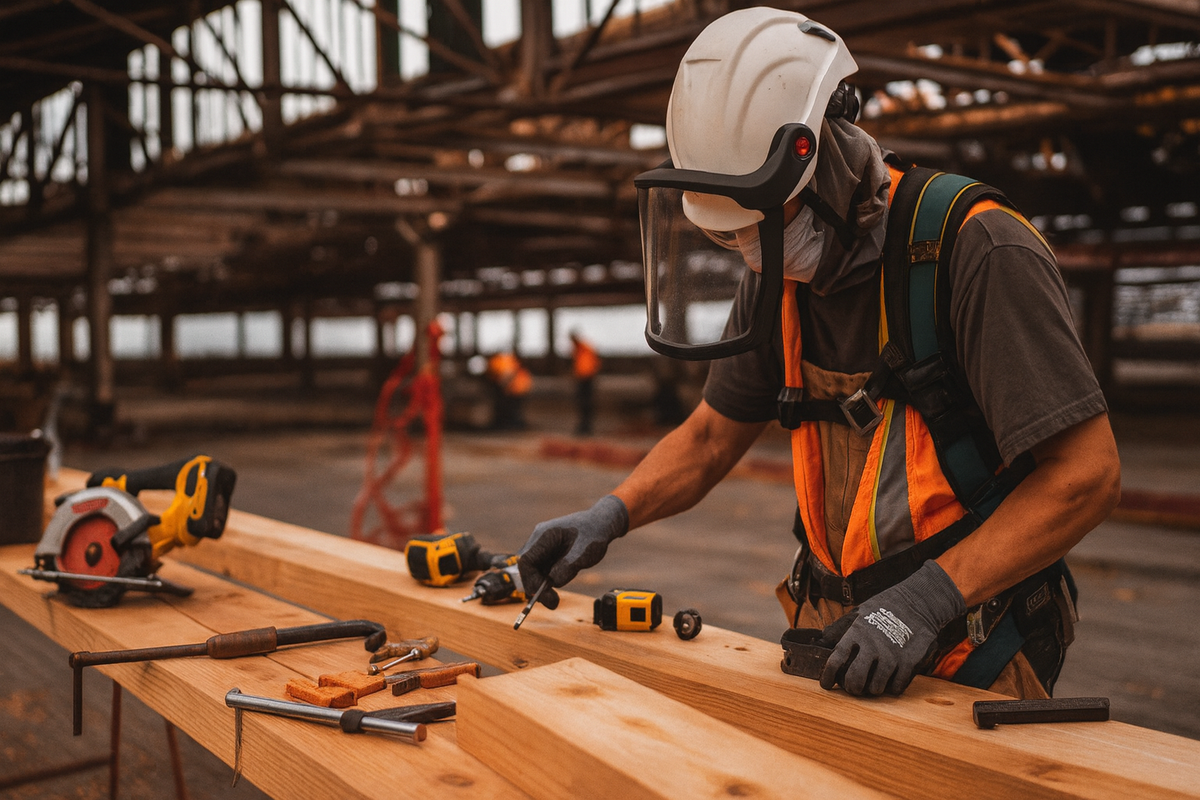
How loud is it on a building site?
Volandis, the knowledge and advice centre for the Dutch construction industry, gives 90 dB(A) as the average level on a building site. That puts you above 85 dB(A), the level at which wearing hearing protection is mandatory. Individual tools go well above that.
Typical noise sources
-
Angle grinderGrinding and cutting95 to 105 dB(A)
-
Circular sawSawing wood and sheet material99 to 109 dB(A)
-
Electric drillDrilling in concrete and stone100 to 120 dB(A)
-
Stone saw, machineAccording to the Arbocatalogus Bouw & Infra100 to 120 dB(A)
-
Hammering, grinding and chiselling during demolitionAccording to the Arbocatalogus Bouw & Infra95 to 115 dB(A)
-
Nailing with a hand hammerImpulse noise from short, loud blows105 to 111 dB(A)
-
Mobile compressor, silencedOften still too loud, even when silenced80 to 106 dB(A)
What you need to keep hearing
-
↺
Reversing alarmsFrom loaders, cranes, forklifts and lorries manoeuvring on the building site.
-
☎
Instructions during liftingFrom the crane operator or the banksman, by radio or within earshot.
-
↔
Colleagues next to youA question or a warning, without taking your earplugs out.
-
!
Alarm and evacuation signalsIn the hall, in the site hut and on the building site. The Working Conditions Decree explicitly names the interaction between noise and warning signals as part of the RI&E.
The noise levels come from Volandis, Toolbox Factsheet Lawaai (average noise levels of sources in construction, in Dutch) and the Arbocatalogus Bouw & Infra (machine sawing, manual demolition, in Dutch). The threshold values are on Arboportaal, the Dutch government's website on working conditions.
Choosing hearing protection for construction and industry
The filter, the rules and what it takes to actually keep earplugs in.
In industry there is continuous noise as well as bangs
The Netherlands Labour Authority (Nederlandse Arbeidsinspectie) names the metal industry, woodworking, construction and the printing industry as sectors where daily doses above 80 dB(A) occur. According to 5xbeter, the occupational health and safety catalogue of the metal industry, grinding or blowing with a compressed air gun is around 100 dB(A) on average.
There is also impulse noise, with short and very loud peaks. The Labour Authority gives straightening metal and working with a powder-actuated nail gun as examples. Those peaks are measured separately, in dB(C).
You can read why hearing protection matters so much on the building site in why earplugs are needed in construction.
Why the DI filter is the standard
Our DI filter from Dynamic Ear Company gives flat attenuation of the low frequencies, so speech stays intelligible. From about 4 kHz it attenuates more, and that is where much of the harmful high-pitched machine noise is. The custom earplugs for construction come with a DI filter with 26 dB SNR as standard.
More attenuation is not always better. The Labour Authority asks for hearing protection that brings exposure below 80 dB(A). Anyone who is heavily overprotected hears colleagues and signals less well and takes the earplugs out sooner. Because the filter is interchangeable, we choose the attenuation per job. The DI series ranges from 22 to 26 dB SNR.
DIM only for impulse noise
On the building site and with continuous machine noise, the DI filter is the right choice. The DIM filter is a level-dependent filter for impulse noise, such as shooting, hunting and fireworks. With normal sound you can still hear your surroundings well, and a loud bang gets extra attenuation.
In heavy industry, for example in a forge or near presses, DIM can be suitable if short, loud bangs are the main problem. For continuous noise, DIM is not a replacement for DI, because its continuous attenuation is lower (15 to 19 dB SNR). In our range, DIM comes in the custom earplugs for hunting, shooting and heavy industry.
What a construction or industrial company needs to arrange
The Working Conditions Decree works with three thresholds for daily exposure.
- Above 80 dB(A) you provide suitable, individual hearing protection and give information. If there is a health risk, you offer a hearing test.
- From 85 dB(A) wearing is mandatory and you make sure it is used correctly. You mark noisy areas, for example with a sign on the site fence or the door of the hall. You carry out a plan with technical and organisational measures and offer regular hearing tests.
- 87 dB(A) is the limit value in the ear, so with the attenuation of the hearing protection taken into account.
The order stays the same. First you tackle the source, then you shield it and after that you limit the exposure time. Only then does hearing protection come in. The Labour Authority expects suitable, individual hearing protectors, especially for permanent staff who regularly work in noise.
Recognisable, so they get worn and lost less often
Skin-coloured earplugs are hard to check on a building site. In your company colour, a site manager or prevention officer can see at a glance whether someone is wearing them. If an earplug is left in the site hut or the van, it is immediately clear which company it belongs to. Colour and logo do not change the protection.
Every pair comes with a cord, clip and case. That way they hang around your neck when you have a quick conversation, and they are not loose in your work trousers.
You can read more ways to make sure your people really keep their earplugs in at how to make sure employees actually wear their hearing protection.
Sources
- Volandis, Toolbox Factsheet Lawaai (in Dutch)
- Arbocatalogus Bouw & Infra, risico lawaai (in Dutch)
- Volandis, Gehoorbescherming (in Dutch)
- 5xbeter, Schadelijk geluid (in Dutch)
- Nederlandse Arbeidsinspectie, Werkinstructie blootstelling aan geluid (2025) (in Dutch)
- Arboportaal, wat zegt de wet over geluid (in Dutch)
Hearing protection checklist for the workplace
Six sections with checklist items on three A4 pages, from noise measurement and RI&E to information and the hearing test. Each item shows the article from the Working Conditions Decree or the Working Conditions Act, and the last page has an action list. The checklist is in Dutch.

From RI&E to a protected crew
This is how we approach a construction company or production site.
Mapping the noise
From the RI&E or noise measurement, we work out which jobs are exposed to which noise.
Filter per job
DI for construction and machine noise, DIM only in heavy industry with loud bangs. You choose the colour yourselves, and your own logo is available from 10 pairs.
On-site fitting
From 10 employees, we come to the building site or the hall. Smaller crews, and anyone who cannot make it that day, visit a hearing centre in our network.
In our own vanHanding out and replacing
About three weeks after the ear impressions are taken, every employee gets their own custom earplugs with a case. Lost them? Then we arrange a replacement quickly.


Questions from construction and industry
Can I still hear the crane operator and reversing alarms with custom earplugs?
That is what the DI filter is made for. It gives flat attenuation of the low frequencies, so speech stays intelligible, and it attenuates more in the high, harmful part of machine noise. Do not choose more attenuation than the measurement calls for. Then signals stay clearly audible too.
Do custom earplugs work with a helmet and safety glasses?
Yes. A custom earplug sits in the ear canal and does not get in the way of a helmet, glasses or face shield. Volandis points out that earmuffs in particular attenuate less well for people who wear glasses and when other protective equipment is used.
Which filter does a carpenter get, and which one a machine operator?
That depends on the noise. Anyone who mainly saws, drills and grinds gets a DI filter. In construction, that is always the DI filter. Only in heavy industry with lots of loud bangs, such as near presses or in a forge, can a DIM filter be suitable. Because the filter is interchangeable, it can still be changed later.
Does it have to be custom earplugs, or are disposable earplugs allowed?
The law does not prescribe a type, but it does require suitable and individual hearing protection. The Labour Authority expects that especially for permanent staff who regularly work in noise. A custom earplug sits the same way every time, while a foam earplug only attenuates as well as it has been rolled in.
How often should the fit be checked?
Volandis advises checking once a year whether the custom earplugs still fit well, because the shape of the ear canal can change.