Interchangeable filters for your custom earplugs
The filter in your custom earplugs determines how much sound is reduced and how it sounds. Audibling works with the DR, DM, DI and DIM membrane filters from Dynamic Ear Company. They are interchangeable, so for a different level of protection you only swap the filter and keep the same earplugs.
How much protection do you need?
Choose where you wear your earplugs. You see straight away which filter suits you and how much it reduces noise. You only need one pair of earplugs, because the filter is interchangeable.
Prefer to compare for yourself? See the table →Choose one or more situations. You will then see here which filter suits you, with its attenuation and price.
Enough protection, without filtering everything out
More attenuation is not always better. The aim is to bring the sound in your ear down to a safe level while you can still hear voices, music and signals. If an earplug reduces too much, you feel cut off and take it out sooner.
The summary of the European guideline EN 458 calls a level of 70 to 75 dB under the hearing protection desirable. Below 65 dB there is a risk of overprotection. Arboportaal, the Dutch government's website on working conditions, writes that custom earplugs are usually matched to the attenuation that is needed, so they do not reduce more than strictly necessary.
As a rough calculation, take the noise around you minus the SNR of your filter. On a motorcycle at 100 km/h it is about 94 dB. With a 16 dB SNR filter you end up at roughly 78 dB.
Sound in your ear with hearing protection
- Below 65 dBRisk of overprotection
- 65 to 70 dBAcceptable
- 70 to 75 dBGood
- 75 to 80 dBAcceptable
- Above 80 dBNot enough protection
We base this on Arboportaal on hearing protection (in Dutch) and the summary of the European guideline EN 458 from 2016 by 3M (PDF). The SNR values come from the Dynamic Ear Company datasheets, see the tables on this page. The calculation example is also on our page about motorcycling.
Which filter suits you? DR, DM, DI and DIM compared
Four series, each with its own character. All filters fit in custom earplugs made of silicone and hard acrylic.
| Filter | Use | Character | Attenuation (SNR) | Interchangeable | Extra cost |
|---|---|---|---|---|---|
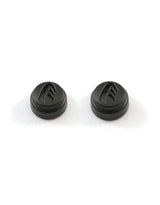 DRGeneral use
|
General use, such as sleeping, travel, the office and loud places like concerts. More about DR → |
Compact filter with good attenuation. The ventilating filter material prevents a blocked feeling and irritation. | 7 to 19 dB | Yes, interchangeable with DM and DI | Included |
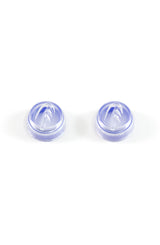 DMMusic & communication
|
Musicians, sound engineers, cabin crew, production staff and racing teams. More about DM → |
Flat attenuation with natural sound and clear speech. The breathable, pressure-regulating membrane gives extra comfort when flying. | 10 to 20 dB | Yes, interchangeable with DR and DI | + €25.00 |
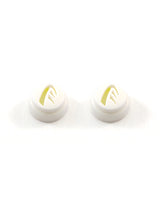 DIIndustry & production
|
Production staff, mechanics and operators, in sectors such as shipbuilding, automotive, construction, the pharmaceutical industry and the food industry. More about DI → |
Flat attenuation of low frequencies, so communication remains possible, and extra attenuation from about 4 kHz against harmful high-pitched industrial noise. Also available in a metal detectable and X-ray visible version. | 22 to 26 dB | Yes, interchangeable with DR and DM | + €5.00 |
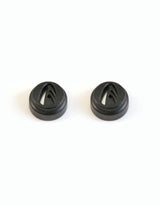 DIMImpulse noise
|
Hunting, shooting sports, defence and heavy industry with hammers or presses. More about DIM → |
Protects against extreme peaks of noise such as gunshots and hammer blows, while you keep hearing space and the direction of sound. | 15 to 19 dB | Yes | + €5.00 |
The attenuation values come from the official datasheets of Dynamic Ear Company (DR, DM, DI and DIM Impulse). The SNR values apply per filter variant and were determined according to EN 352-2. In custom earplugs the attenuation can differ, depending on the fit and the shape of the ear canal.
Attenuation values of all filters
SNR is a single number for the average attenuation. H, M and L show how much a filter reduces high, medium and low frequencies. This also shows how flat a filter attenuates. With the DM 25 the three values are within 1 dB of each other, with the DIM 9 there is 12 dB between high and low.
| Filter | SNR | H | M | L |
|---|---|---|---|---|
| DR seriesGeneral use, such as sleeping, travel, the office and concerts | ||||
| DR 20 | 19 | 19 | 17 | 14 |
| DR 15 | 16 | 16 | 13 | 11 |
| DR 10 | 9 | 11 | 5 | 3 |
| DR 5 | 7 | 9 | 3 | 1 |
| DM seriesMusic and communication, with flat attenuation | ||||
| DM 25 | 20 | 19 | 19 | 18 |
| DM 20 | 17 | 15 | 18 | 18 |
| DM 16 | 16 | 16 | 13 | 12 |
| DM 15 | 15 | 15 | 13 | 12 |
| DM 10 | 10 | 10 | 6 | 6 |
| DI seriesIndustry, construction and production, with extra attenuation of high frequencies | ||||
| DI 30 | 26 | 26 | 23 | 23 |
| DI 25 | 24 | 23 | 22 | 21 |
| DI 20 | 22 | 22 | 20 | 18 |
| DIM seriesImpulse noise from shooting, hunting and fireworks | ||||
| DIM 19 | 19 | 22 | 16 | 13 |
| DIM 12 | 19 | 21 | 15 | 13 |
| DIM 9 | 15 | 19 | 12 | 7 |
The values come from the Dynamic Ear Company datasheets for the DR series, DM series, DI series and DIM Impulse series. The attenuation was determined according to EN 352-2. According to the manufacturer, the attenuation in custom earplugs can differ, depending on the fit and the shape of your ear canal. The DM and the DIM are also available with a switch. In the closed position the attenuation is then SNR 25 dB (H 27, M 22, L 20).
Why membrane filters?
Why we choose membrane filters instead of simple tube filters.
Natural sound
Membrane filters let sound through evenly, so music, speech and ambient sound stay clear and undistorted.
Protection without shutting you off
Harmful peaks and loud tones are smoothed out, but you stay in touch with your surroundings.
Comfortable for long wear
You avoid the “under water” or “blocked ear” feeling that tube filters often give.
Reliable attenuation
Membrane technology gives consistent and predictable noise reduction across different frequencies.
Drawbacks of tube filters
Unnatural sound
Distortion of music or speech, often with a dull sound.
Uneven attenuation
Some frequencies are reduced too much, others too little.
Less suitable for professionals
Musicians, technicians and people who need to communicate find them disturbing.
Earplugs with or without a filter, what is the difference?
An earplug without a filter blocks your ear canal completely. With an earplug with a filter, sound enters in a controlled way through a small filter. You notice that difference in four ways.
- You know in advance how much it reduces. A solid earplug reduces as much as the fit allows, and you cannot adjust that later. For a filter, the manufacturer measures the attenuation and states it as SNR and as H, M and L. Those values are in the table above.
- You can still hear your surroundings. With a membrane filter, music, voices and signals become quieter, but you can still understand them. A solid earplug also blocks the sound you actually want to hear.
- Your ear stays ventilated. According to Dynamic Ear, the filter material of the DR, DI and DIM filters keeps letting air into your ear. That reduces the blocked feeling, the occlusion effect, and irritation in the ear canal. The membrane of the DM filter also regulates air pressure, which is pleasant when flying.
- You can swap later. If you start using your earplugs for something else, you only replace the filter.
That is why all Audibling custom earplugs have a filter. If you want as much attenuation as possible, choose a stronger filter such as the DI 30 with 26 dB SNR.
Flexible protection with interchangeable filters
Thanks to the design of our custom earplugs, the filter is interchangeable. So you do not need new earplugs to get a different level of protection. All filters are available for custom earplugs made of both silicone and hard acrylic.
Questions about filters
Which filter do I need?
That depends on where you wear your custom earplugs. DR is for general use, DM for music and communication, DI for industry and production and DIM for impulse noise such as gunshots and hammer blows. Not sure? Ask one of our partner hearing care professionals for advice.
Can I switch filters later?
Yes. You swap the filter yourself, so you do not need new earplugs for a different level of protection. You can order an extra filter set with two filters separately.
What does SNR mean?
SNR stands for Single Number Rating. It is a single number for the average attenuation of a hearing protector. H, M and L give the attenuation of high, medium and low frequencies. The higher the number, the more sound is reduced.
Does a different filter cost extra?
The DR filter for general use is included. For a DM, DI or DIM filter you pay an extra cost. You can see it in the comparison table above and in the Designlab.
Do the filters fit in acrylic and silicone?
Yes, all filters are available for custom earplugs made of both silicone and hard acrylic.